Showing posts with label books. Show all posts

Thursday, July 18, 2019

BOOK REVIEW: The Devil and His Boy by Anthony Horowitz


History has turned into something amusing, finally!

Situated in 16th century Tudor, London, this story is about a boy named Tom Falconer who grew in an inn in Framlingham. He claims to be an orphan, only living as a servant. Yet, as the story advances, it revealed that he is Queen Elizabeth’s grandchild to Thomas Seymour, his Protector (or knight).


Thrilling and fast-paced, it became a ticking-clock scenario: while being hunted by Ratsey, he has to race against time to save the Queen from an assassination plot.


C.S. Lewis wrote, “A children’s story that can only be enjoyed by children is not a good children’s story in the slightest”. I know it rings true because I am still enthralled to flip it every time—and I am 23 years old! The Devil and his boy is an amusing read across all ages because the vocabulary is so simplistic yet profound.


If it were like a graphic novel, it will be Oliver Twist that portrays the slum Victorian era: desecrate yet equally poetic and worth reading.


Horowitz’ characters in the story are also well-researched because they had existed in real life—Shakespeare, Moll Cutpurse, John Dee, and others. The author is talented in storytelling by making the lives of these people more colourful and interesting.


Considering this is a children’s book, just like John Green’s Looking for Alaska, it can be a home reading assignment (god I miss those days in the early 2000’s!) and/or as a book club discussion. It is a good two-hour read short novel for thrill-seekers.


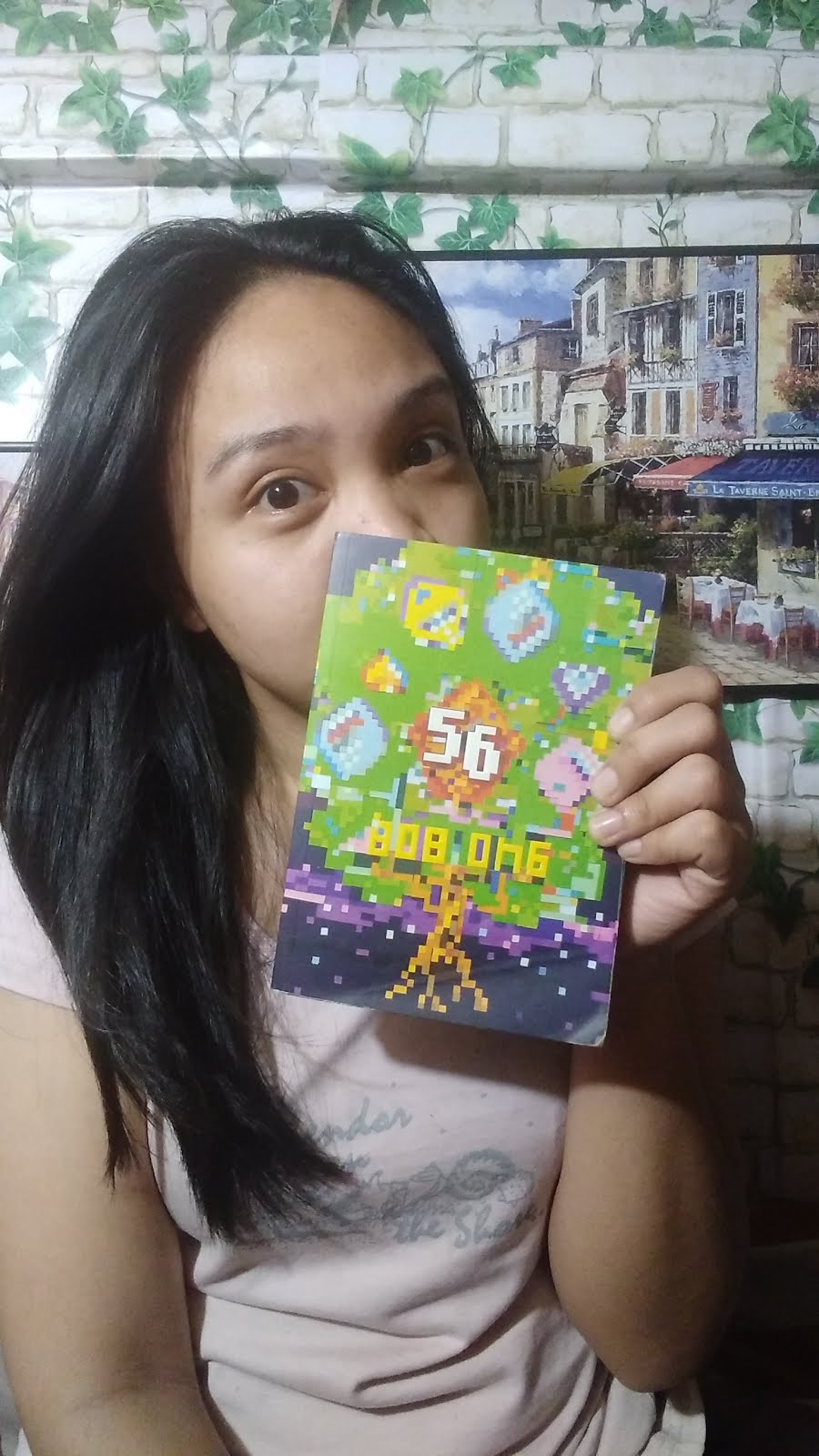
BOOK REVIEW: 56 by Bob Ong


I had a hiatus for the last three, or five months. It's nice to write again. Woooooot! Although of course, my writing. RIGHT. I'm lacking practice these days. If you think this book review is lame, please do tell me. Yikes!

 
Bob Ong's seventh book talks about multitude of subjects about his family, the voices inside his head he called "Pokemons", logical fallacies of internet trolls, social media etiquettes, grueling long queues of government offices, how to be a better reader, being a responsible voter, living alone in a big city, and ultimately... marriage.

As usual, his target audiences are young adults as he addresses "coming-of-age" advices about growing up and learning the cheap tricks of the society.

Once again, he proved to be a trusted writer (and yes, he impresses me a lot) as he had done numerous research to come up with the conclusion that he wants to get across. We don't know his true identity—he has been very secretive about it—but he finally solidified his mark in the literature by his no nonsense opinions, and backing it up with his well-researched and reliable information. Away from the usual light subjects like ABNKKBSNPL Ako, Ong shifted into more socially relevant topics to make the next generation turn their focus away from themselves to outward events that makes them functional and responsible adults.


Pandayan bookshop told me that his works are under Malikhaing Sanaysay or Creative Essays (or Creative Non-fiction?) genre, so it never has a definitive plot and characters to begin with. Yet, this documentary is a detailed with enumerations and knock-out jokes that I can’t help but wonder how much time he has with his hands. He has read a multitude of topics to create something substantial and yet so close to the masses.

The tone of the voice is very conversationalist yet professional. There are even moments that I am reading this on the bus. Additionally, the erotic pages are humorous (because really, the sexual metaphors are so off-key and... eww) to re-catch the attention of these "semi-children" when the topic gets boring/serious. I must admit, his storytelling was very light, as he chooses a simple set of vocabularies, so I never see it as anything boring. However, if the reader is far younger, a little less ready, or a little more teen, these pages are awkward yet effective mood-shifters.


Last year, I finally had the time to read Mga Kaibigan ni Mama Susan and mentioned in my book review that it lacks unity to build up the tension of the cliffhanger. In his latest book, he finally addresses it, on chapter 55, and I quote: "Mas mabuti na ang librong maraming sinasabi kumpara sa librong walang sinasabi" . At some point, he has silenced my doubts if he can really write a cohesive manifesto with only a single topic. What I realized is, I don't really have to tell him what to do with his writing style. I just have to understand what makes Bob Ong a writer, and accept his writing style the way other writers respect each other.


Blah, blah, blah, gibberish. I'm sleepy.


*** I am planning to write a book review about The Handmaid's Tale, or anything classic, but I feel I don't deserve to write a review about it. The book might get butchered in my undeserving hands. Hehe. Haha.


Sunday, May 20, 2018

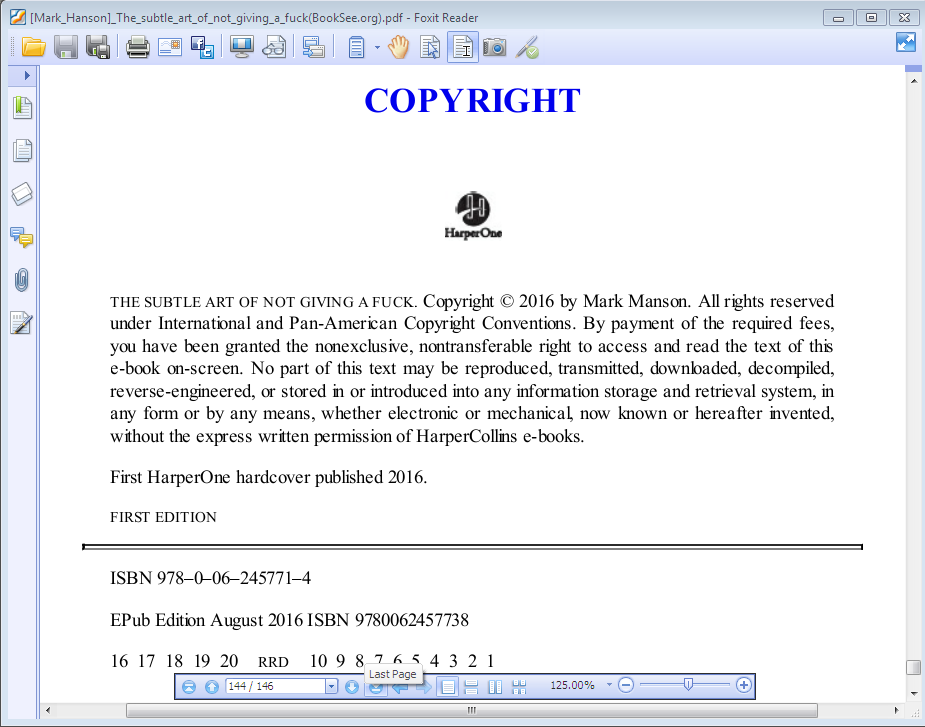
BOOK REVIEW: The Subtle Art of Not Giving A F*ck


I think I found the book The Subtle Art of Not Giving a Fuck on instagram, propped up beside a lovely coffee mug with a tear-jerking caption that can make Michelle Obama cry. Somewhere around 2016, this book is a hit because number one: it appears on every book website I visit, and number two: damn, the F word sounds nice. Haha.

This is probably the first book that agrees with my rather careless life decisions. Am I REALLY careless? Are my virtues malleable and therefore easily persuaded? Or maybe something more: that I wouldn’t pay attention on my make-up because I have to update my résumé, or I would deliberately pick ukay-ukay than any high-end clothes shop because I don’t know… its way cheaper?

Then it dawned on me: we all have different filters in making decisions. Mine is self-improvement and happiness—EVERYTHING ELSE DOESN’T MATTER. I have known POVERTY since the day I was born, so I would rather be broke and happy than to be rich and miserable. Fuck it all. Therefore, maybe I was never really reckless jerk at all.

No copyright infringement intended 


Sorry Paris Hilton, I don’t want to be you. Please don’t get offended. I mean, I can’t be you because I can’t stomach the horrors of blind dating and fake flattery. YOU CAN. Who likes to be anybody’s trophy girlfriend? It sucks.

Choices, the value of suffering, and finding your self-identity by NOT giving a fuck at all—these are the things that might get you mind blown within 146 pages. It’s really short, actually, given that I’ve read it on PDF. But it’s worth reading, if you are willing to get your ego crushed so new perspective will blossom.


 I could kiss the author right now. Seriously.


Friday, January 12, 2018

BOOK REVIEW: Gapo by Lualhati Bautista

Mostly, novels have two possible outcomes: the good, and a tragic. The resolution may disappoint us, making us understand the frailty of human—on the other hand, there are stories that positively sheds a light of hope for the readers. In the end, the “absoluteness” of some conclusions are far more predictable than others.


The book Gapo, by Lualhati Baustista is way beyond that. Talking about the love-hate (and rather exploitative) relationship between Filipinos and Americans, it made me see that having no change is worse than a tragic ending at all.


Gapo by Lualhati Bautista talks about the tale of Magda, a prostitute in Olongapo, and Michael, a half-Filipino whose heart is seething with anger for Yankees. After a series of struggle between those them, and the clashes of their ideals, Magda still tragically becomes pregnant of her “boyfriend”, which later reveals already a married man.


This circular story sinks hopelessness deeper that after reading, you must accept that reality is so much complicated that what it looks like. No force on earth cannot change the way of Olongapo. No wannabe hero must dare to solve the problems of a sick society. The Filipino-American relationship roots deeper than the garbage exports and lustful Yankees being thrown in our land—for it is ingrained in our mindset, that terrible and disgusting colonial mentality.


I also like the commentaries in-between: Bautista talks about unfair quality of export products, how we are so accepting of their substandard products, and how Filipinos can almost die for the elusive American dream. There’s also a lot of subplot that makes the story alive, like Modesto, Jun, and William.


Overall, the only round character capable of shifting viewpoints is Magda. At the end of the novel, upon knowing that she’s been pregnant again by a Yankee, she ended seeing Michael’s viewpoints. She finally understands that illusory fairytale that every prostitute wants are just blinders that makes Americans more exploitative, and Filipinos more abused and beaten. 

Saturday, November 4, 2017

The Blame Game (I have read the first chapter of Dale Carnegie's book)

Insane criminals never blamed themselves for anything. They just believed they are just defending their over inflated egos. They use reasoning, fallacious or logical, to justify their anti social acts: like dehumanizing their "enemies" with vindictiveness and insulting remarks.


They will NEVER understand what you feel; in fact, they will justify it even more. It's like talking to a brick wall.


BOOK REVIEW: Mga Kaibigan ni Mama Susan by Bob Ong


Bob Ong’s comical books has been already know for every Filipinos for years. After his debut work ABNKKBSNPL Ako, most of his works has gained an equal popularity for his comical style and witty lines. This time, his latest book Mga Kaibigan ni Mama Susan ventures a different breed of genre (I wonder what are the things he cannot do more than what he can). Gather your fires and pull up your blankets, because this kind of thriller makes your skin crawl and hairs rise in fear.


This is a series of diary entries of a college student named Gilberto—who has a recurring nightmare of a woman in black. Whenever he dreams of it, he wakes up in the morning panting and drenched in sweat. But alongside that, he has difficulties with his aunts and uncles. He is shouldering the chores all the time. He is the least favorite in the family, and most of his cousins are getting better privileges in the house than him. After finding out his grandmother has grown sickly, he decides to leave the city and look after her in a small province. He founds out that his lola (grandmother) has an almost-religious group “Kapatiran” which the whole province relies on, after banishing a Catholic priest. After a chain of horrendous events, like hearing their religious chanting, and somebody always taking his pen (so he cannot write in his diary), he realized that the Kapatiran was not just a group, nor anything that praises Jesus Christ.


With no electricity, mobile devices, or any help with the adjacent cities, will he able to escape his grandmom’s cult and the “Kapatiran” women?


Even though it is crafted effectively to scare the readers, its whole excitement is crammed at the end of the novel. The exposition is quite long, that isn’t attached to the conclusion. The narration of his school life didn’t rise up to strengthen the ending of his grandmother. I’m aware that it’s supposed to be a student’s diary, but having lots of incoherent angles in one book weakens its fluidity and oneness.


The Latin words gave rise to the climactic cliffhanger. Albeit the slow pace of the book, I like the way it ended.


Well, it works the same way in real life. Sometimes, we cannot control the people we love, and if they morphed to a monster we don’t know they are capable of, the best thing we should do is to simply run away and save ourselves. The guilt of leaving your family is unbearable, especially if you have a family like Gilberto who is guilt tripping you all the time, but there are moments when we have to think for ourselves and start saving our sanity.


After a long ride of eerie and disturbing experiences, this book from Bob Ong will let you have a taste of troubling rituals and terrifying nightmares. Coming from a life of a normal kid, it is enjoyable for it is seething with mystery.

Wednesday, October 11, 2017

Book Review: Kung Alam Nyo Lang by Ricky Lee


Ever had a children’s story that has an underlying creepy lesson inside? Maybe, you have made familiar with your favorite story when you were a kid, never knowing it’s more than a bedtime fairytale? With the Ricky Lee’s latest venture, Kung Alam Nyo Lang, four childhood stories of coming-of-age will send you the chills of adulthood… in a child-like setting.

Avoiding spoilers, I tried (so hard) not to give away too many details of the book.


Ang Nawawalang Diyos

            A cliché story of discovering yourself by finding God (and not Nemo), the story spices up with Carlo’s two pets, his dog and cat. Since this narrative is already dime a dozen, it seems just the “click bait” of the book to reach the common audience—but for me, it’s my least favorite.

Ang Sayaw ng mga Letra

            I didn’t see the ending coming. Depression can seep in with years of neglect and denial. Inches away from the ending, it urges you to look at mental illnesses in a different light.


Si Inggo at ang Santo Kuwatro

            Reopening the issues of bullying, it teaches us power of word of mouth. It helps you realize how it can move people—it can haunt you, inspire you, surprise you, and yes, it can also be twisted for personal glory.


Nang Mapagod si Kamatayan

            The defamiliarization of immortality is genius.


                         Even though my PHP 350.00 only lasted for 2 hours (excluding the time I prepared for my midnight coffee), trust me it’s a good read. In fact, my emotions are running wild as I flick through the pages. It’s the type of dark stories that make you see a flash of light. Giving us a tinge of hope, it signals the readers that emotional warzones of growing up has a rainbow.


People change with time. There are things that happened to a person in his childhood and years later they seem to him alien and strange. I am trying to decipher that child. Sometimes he is a stranger to me. When you think about when you were 14, don't you feel a certain alienation? 

- Gunter Grass


Sunday, October 8, 2017

BOOK REVIEW: Boys are Dogs by Leslie Margolis


When we were young, prepubescent problems seems like forever. Add the idea of parent’s separation, moving to another city, not seeing your friends anymore …and dealing with boys. Luckily, here is a book for sixth graders that teaches them how to train them, like a dog does.

Boys are dogs by Leslie Margolis is about Annabelle, an 11-years old student who just moved in as a sixth grader at Birchwood Middle School. She carries with a lot of changes going on about her. Her mother got a new boyfriend. She moved to another state. She switched schools, where she has barely no friends at all. One more thing: she has a new dog she needs to train. Only with a puppy-training book on her hand, she needs adjusting with a dog who eats up and chews on everything, and dealing with schoolyard bullies at the same time.


She has learned that training her dog Stripe, who eventually becomes Pepper, is not really different from standing up from boys who calls her names, snatches her homework, and steals her friends’ tables in the canteen.


Having a catchy title, not to mention derogatory for some, this books is clearly for young women—dealing with a pack of wild dogs called boys (her words, not mine!). The story is entertaining and easy-read, plus the humor is witty.  Contrary to a casual girlhood crush relationship, the theme is quite different, especially in developing the reader’s confidence department. It teaches a strong wit among the newbies in school. The simplistic vocabulary is impressive, because the story is relevant and classic difficulties of a child. Reflective as she is, Annabelle proves that emotional struggles can be solved slowly, through his puppy-training book.


Annabelle changes a lot through the chapters, turning herself into a “dominant dog” for Pepper and Birchwood boys. The other characters as well, has learned how to adjust to changes. Her stepfather Ted whom he calls “Dweeble” has managed to talk to her—though not entirely successful in keeping a connection to her new daughter. Then Jackson, an eighth grader who calls her “Spazabelle”, soften a bit until he gets along with her. Mia and Sophia, on the other hand, finally grows into young women who has their own eye candies. Clearly, this is a coming-of-age book full of problems and self-discoveries.


While some stayed the same, but the entirety of the story expects a lot of coping and growing up. It is light-hearted yet not boring until the end of the page. Young readers can relate to the theme of the story—the glories and all its mishaps.  

Friday, September 22, 2017

BOOK REVIEW: Bright, Catholic, and Gay by Danton Remoto


Switch channels and change your tabloids—we are already tired of cold headlines and passive-aggressive remarks of public personalities. Media has been a way for different perspectives, including the miscued and over-the-top.

Luckily, we have something that oozes with brilliance and fresh ideas. A book with 21 essays, Bright, Catholic and Gay by Danton Remoto offers us witty, disturbing, and even provoking issues that keeps you intrigued until the last page.


Being known as a founder of Ladlad Partylist, the book focuses on LGBT about everything—political stands, successes, closet lives, and social “scarlet letters”. After reading this, conservative Filipinos will get the somehow full picture of LGBT life. What’s so unique about Remoto is his (or her, there’s no politically correct pronoun yet) narrative of how ordinary gayness is. Their love of God. Partners with risks of HIV.  Finding love. The harsh and unmoderated comments on the internet. Coming out and liberation. Everything.


Back cover


Aside from that, there are queer literature and erotic fiction featured, reviewed by Remoto himself. As if a beginner’s book, it propels the readers to dig deep into the life of pink warriors. Easy-read yet sensitive, it excites you have a leap of faith delving to the almost outcasts.


Personally, I don’t have a lot of gay/lesbian friends because I barely have friends at all (haha). My circle of networks are small and neat. However, the “pink community” amuses me a lot, and the book has become a way to understand them better. They have an equally colorful lives, maybe more. Fighting against the common stereotypes, they bravely shed denial, shame, guilt, and self-loathing. As a feminist (yes, you read it right), we are in the same page on sickening gender biases and our supposed “place” in the society.


(The Breakfast Club, 1985)


Gathering his stories from all walks of life, Bright, Catholic—and Gay is a fresh look on LGBT life… from shadows, out into the light.


Wednesday, September 20, 2017

BOOK REVIEW: Good Boss, Bad Boss by Robert Sutton


You probably have a weak will-power. You also may be a pushover. Or a people-pleaser. On the same note, your friends and colleagues may think you’re a control freak, dictatorial, or annoying. In either way, you playing with power is like juggling TEN balls while the crowd is poking fun at your freak show.


You don’t need to be “The Big Guy” to read Good Boss, Bad Boss by Robert Sutton—for anyone who handles people, or wants to gain a reputation of a good boss, this is a self-help to soothe the power plays and find a balance between competency and humanity. Whether you are a teacher, doctor, lawyer, businessman, or even a mother—this book will be a sound and fun ride.


As a teacher, I once had a tough ride with classroom managing. Kids are kids, as they say, but I don’t want my class to fidget and throw flying papers around. My teenagers grab their phone and text while I teach.  On my first years of teaching, sometimes I give in to their petty requests. Vox Populi, Vox Dei is really a thing in classroom, by the way. Joke’s on me.

Now I don’t want to spoil the whole book for everyone, but if you want a takeaway, here’s some:

·         They look up to you. Get used to it. All your weird tendencies are being watched. Set the tone from the beginning—and set it right—because you will be under the microscope from this day on.
·         Be decisive. Apart from being well-informed, great bosses know that fear and uncertainty is contagious, and the whole team will be affected. If you take charge and give them a security blanket, even if there isn’t any, the team will perform better. Rule of thumb? Thou shalt not be hesitant.


·         Balance the power play. They say that if you really want to know a person, give him power. Good bosses know this, so they dance on the edge of overconfidence and humility. They know they are in charge; however, a healthy dose of self-doubt is needed to save themselves from arrogance.
·         Deal with the rotten apples. Destructive employees can undermine the performance of many good people. By eliminating the rotten apples, or strategically make them interact less with others, work relationships will be more humane, harmonious, and motivating.


·         Talk and Act. We all had that blabbermouth leadership, right? Good bosses understands the work they manage, so they act appropriately when need arises. Also, they make their commands neat, simple and repetitive rather than the incomprehensible jargons of smart talks with no action.
·         Shield your people. From petty jobs, unnecessary meetings, and time-consuming protocols—great bosses let the workers do their work. They empathize enough not to waste anyone’s time, or kill anyone’s productivity in the process.
·         Do the “dirty work”. Do not delay any painful decisions and actions that can hurt other people. Anything along the lines of issuing reprimands, firing people, or denying requests are all part of the work.


With tons of interviews and exemplary leaders to make each point clear, Good Boss, Bad Boss is a textbook for struggles in power play, with a little tinge of sarcasm and throwing shades. The tongue-in-cheek tone is apparent. Sutton clearly plays with his readers while informing them through the pages. After reading, there’s a bit of entertainment that stays (not to mention, you didn’t get too roasted).

Thursday, August 24, 2017

Reading and Modern day Sorrow

Reading and Modern day Sorrow

We read to weep but why do we need it when we have our own lives to deal with? Ah, it is the exasperation in blindness, the burst of thoughts, the orgasm of possibilities, the trapdoor of the magical act. This is the escapist key to pleasure Eden. Gossips are what we aim for, for we aren’t satisfied yet in our OWN lives—we like another one.  Sometimes more happy, more enriching, more adventurous and sometimes more deprived, sadder and uglier but yes, we all like to live a million lives. People are never satisfied with a single existence; that is why we escape to the concepts of afterlife (which I believe in, which makes me another escapist) and reincarnations to make themselves believe that after bodies got rotten, our existence doesn’t just stop there.

We need a continuation of our own drama, even though it hurts because we are so used to suffering that we associate it always to living—heedless of its naiveté. So unconsciously or subconsciously, people connects “living” with “suffering”. It is the hurt, sacrifice, bleeding and choking that makes us feel human. To suffer is human.

I find people saying “they hate drama” every once in a while—but then, aren’t we living to suffer? As Buddhism claims, life is full of suffering. People who complains too much are so spoiled and laid back that they forgot they will die eventually. I call these people dehumanized, for they are no better than a computer that abides at your command. They are not human anymore, for their feelings have degraded into a worthless machine incapable of thinking and appreciating a treasure that’s already in front of them.

Acting like a machine, however, doesn’t make them one. People will eventually receive their own taste of free fall, hitting rock bottom and being beaten several times. When it finally comes, the dehumanized would think that they would survive just by their heads. NO! The safest way to get along with this foolishness is not logic, pen and paper, or back and white; but of hearts, acceptance and forgiveness. It is not dictatorship that wins the people, but free will. Solve equations and draw blueprints every day, huddle in your small room for security, but remember: life is much more enriching when you let your guards down, walls collapse to taste the sweet air tender against your cheeks of the Grand Canyon of unsolved mysteries.

Through reading, we can be a royalty, a victim, a criminal, a conman, a clown, or maybe a fool. I find it fulfilling that these simple pages and thin strips will make you strong, thick and rich. Again, we read to discover a thousand lives—like a ghost floating, a guardian angel, a spectator of a show you’ll never get a part at. Swim and puddle at the thoughts of your mind.

P A N D E M I C

            Let my start by saying an apology because I am running and going back in this blog  only  when I am stressed which explains my c...